Showing posts with label Adenium obesum (Desert rose). Show all posts

Friday, February 22, 2013

Adenium obesum - Desert rose

I've always thought of Adenium obesum (Desert rose) as miniature Frangipani (Plumeria). The strong resemblance is in the bare fleshy stems carrying terminal leaves and bunches of flowers. Both have thick succulent stems which exude a milky sap when any part of the plant is cut. But here the similarity ends, as the stems of the Adeniums grow increasingly in girth, thereby earning its moniker 'obesum'.

The Chinese consider Adeniums as  auspicious plants. 

As if mindful of their obligations and duties, my Adeniums bloomed right on cue, just in time for the Chinese New Year. It is framed by the fan-like leaves of the Licuala grandis (Fan palm).


This has chilly red flowers and white corollas. It is always the first one to flower. I take this as the harbinger of the Adenium season when the weather is warmer and dryer. 

However, throughout the CNY period this year, it has been raining cats and dogs . Certain parts of the city were flooded.


 Blooms last up to a week if placed away from direct sunlight. The uprighr blades of Walking Iris is to the left.

The petals are thick and feels velvety while the white corolla is covered with fine hairs and this extend to the stamens too.


This photo of the Adenium plant was taken about 18 months ago. 
This was taken about one year later. As you can see from the two pictures above, Adeniums grow slowly.

At the moment, about 8 months later, the only two branches have grown longer. It looks leggy but I let it be as it always seems to be blooming. The Calamansi plant is from two CNY seasons ago. Fruits are scanty as they have been harvested for adding zest to drinks and food.
 

This variety is white with radiating tongues of red from the centre towards the edge of each petal.

 
The flower is basically white, trimmed in black and red. 


As the flower matures, the white portion gradually turns to pink


while the black trim turns to dark purple.


This has a pink lavender hue and a deep red to maroon corrolla 

 
In the pink variety, the stamens and stigma appear to be fused together.

A single seed pod has many seeds. Tufts of hair are found on each end of the seed.


Year of the Water Snake (2013)
A pink Adenium obesum to signify the celebration of the Spring Festival according to the Chinese solar-lunar calender. The double-headed snake bangle is from my sister's antique silver collection.


Sunday, February 10, 2013

Chinese New Year and Spring Festival 2013

On the 10 February 2013, as the tail end of the dragon is seen trailing out, the water snake slithers in to herald the year of the Snake. It is the sixth animal of the Chinese zodiac.
 
A hissssssssy welcome to the kitchen by a friendly red snake. According to the ancient Chinese, a Snake in the house is a good omen because it symbolises a cornucopia of abundance for the household.


Ornaments for the festival usually have connotations of good fortune, good health, longevity, peace and prosperity.  The fish 'yu' for example denotes abundance. For the farmer, it would indicate a bountiful harvest. For married couples, they hope to have lots of progenies to populate the earth :)


Nian kau, a form of glutinous rice cake is traditionally offered to the kitchen God so that he would give a good report of the household or to seal his mouth if the report is negative :) Its yummy when sandwiched between a slice of yam and sweet potato, then fried to a crisp. Goes well with Chinese tea or kopi-O.


I remember eating Honey-comb cookies made by mum when I was a child.


A selection of traditional cookies
  
Topmost: egg roll (love letter) and spicy shrimp rolls
From 3 o'clock, clockwise: pineapple, chocolate-nut, butter-potato, green pea and peanut butter cookies.


Mandarin oranges (kam) is the homonym of gold in Chinese so is the most ubiquitous fruit around. It is one of the most popular gift to relatives, friends and business associates. The pomelo is used in a highly celebrated tossed-up salad dish 'yu sheng' which is frequently served on the seventh day or Man's day.

Green bottle gourd,  (Lagenaria siceraria) known as 葫芦 (hulu) in Chinese is a highly regarded fruit as it signifies happiness and wealth. In the olden days the dried gourds were used as flasks for water or wine. This one here has an image of a fish etched into it with a blowtorch. The fish image symbolises surplus or abundance.


  Plum blossoms (梅花) are traditionally symbolic of Chinese New Year as it is quintessentially spring.


A layered paper cut-out of colourful peonies for the door.


The leaves of the Draco are ornamented with tiny fake gold ingots.

Adenium obseum is another auspicious plant. Somehow at this time of the year all eight of my Adeniums are blooming.


A eight-foot tall braided Pachira aka money tree placed at the entrance and gilded lanterns ...

light up the driveway by night.


This is the Chinese character for snake. On the ang pow (a red envelope for placing money to be given away to children, family members or staff) packet from CIMB, is a stylised calligraphy of the character for snake.

 
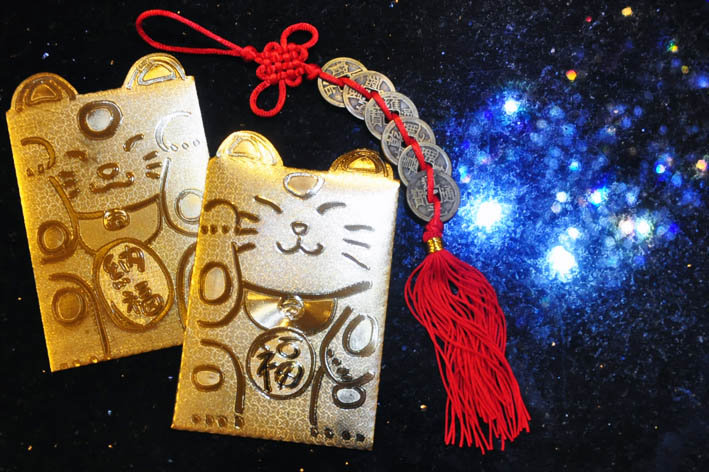
These prosperity-cat ang pow packets are from my parents. Originally from the Japanese creature, 'Maneki Neko', it is now widely adopted by the Chinese as the 'Zhao Cai Miao' or Beckoning Prosperity Cat.

Tasha getting in the mood for Chinese New Year and Spring Festival. She is seen here in a pose of the Beckoning Prosperity Dog. Tasha joins us in wishing all Chinese, and friends who celebrate the Spring festival with these felicitation:

"Wan Shi Ru Yi" meaning “May all your wishes be fulfilled”
 

LinkWithin

Related Posts Plugin for WordPress, Blogger...