Showing posts with label Cyrtostachys renda (Lipstick Palm Tree). Show all posts

Thursday, March 17, 2016

Dianella tasmanica 'Variegata' - Tasmanian Flax Lily

Dianella tasmanica 'Variegata' (Tasmanian Flax Lilygrows up to 2 foot tall. I plant it for its bold white striped leaves as it makes a nice accent as an edging plant. The local florist has often times used it in their bridal bouquet.

The Tasmanian Flax Lily has strappy green leaves edged with contrasting white stripes. It is thus grown primarily for its bold beautiful foliage.

ts a low-maintenance plant and can survive relatively long periods without watering. 


As it grows best in light shade I planted at the base of a Lipstick Palm Tree (Cyrtostachys renda)


The flowers are small, with alternating baby blue sepals and white striped green petals.  Dark blue berries may form after flowering.

I'm amazed that butterflies can find this tiny flowers interesting while there are many other bold and attractive flowers around.


On the left, a container of Dianella tasmanica 'Variegata' placed next to Chlorophytum comosum (spider plant)


Chlorophytum comosum thriving at the base of a Bougainvillea plant.

An Oriental Magpie-robin (Copsychus saularis), perched on the rim of a container with the Tasmanian Flax Lily in the background.

Tasha looking bewildered when the Magpie-Robin flew off as she approached. She loves chasing birds and gets extremely vexed when her efforts were in vain.

Friday, February 7, 2014

Dendrobium Orchids and the Carpenter Bee

Much to my delight, a Dendrobium orchid attached to the Cyrtostachys renda (Lipstick Palm Tree) suddenly put forth a short spay of only six flowers


This happen without any effort from me. I do not spray any of the tree-bound orchids with fertilizer or even water them as I treat them as parasite of the palm tree.
This Carpenter bee was methodical in its visit to the flowers.

 
It first buzzed its way to topmost left flower (No 1).

It then retreated and 

visited flower No. 2 which is the immediate flower to the right and so on.


Cyrtostachys renda (Lipstick Palm Tree) is a very slow growing palm. This clump is about 20 years old.

At the base of the mature stems, numerous new stems have sprouted. These can then be successfully propagated. They can also be grown from seeds, but this method takes a long time.


Volunteer ferns (corsage fern) on base of palms

Wednesday, January 15, 2014

Mansoa alliacea - A Garlicky Vine

Mansoa alliacea (garlic vine) is a woody, flowering liana. The plant is a climbing vine and can be trained into a woody tall stem over time. Pruning is best done immediately after flowering so that it does not look straggly. It can easily be propagated from the semi-hardwood cuttings. 

The garlic vine is so-called because of the garlicky smell that emits when the  leaves are crushed. A faint garlic odour can be discerned from its blossoms.  However, it is not at all related to the edible garlic.

 
 Flowers are trumpet-shaped and produced in dense clusters. This vine is not a frequent bloomer, producing flowers occasionlly.  However when it blooms, the flowering is profuse and indeed spectacular.

It is a prolific bloomer when it decides to bloom. The entire vine can be covered with flowers.


Each starts off with deep purple petals and changes ...

 
... to a lighter shade with age ...

 
 ... and finally fading to white before it turns brown and drops off from the vine.
 

When the clusters are fully blooming, one can see three different shades of colours (lavender-purple, lavender-pink, pale lavender, white) on the plant.

 
This garlic vine had attached itself up on the fronds of the of Cyrtostachys renda (Lipstick Palm) for support as it climbs upwards to reach for sunlight. 


It can sometimes be unruly and scrambled over other plants for support. Here it has sought support  from the Hibiscus shrub.


Wednesday, August 14, 2013

A Bulbul's Prized Catch of the Day

I spotted this Yellow Vented Bulbul (Pycnonotus goiavier) rustling admist the branches of the Hibiscus shrub with something in its beak. I quickly zoomed in and snapped a couple of shots. It was only when I zoomed in the camera for a preview that I realized that it was a young gecko or house lizard.

Hibiscus rosa sinensis 'Madeline Champion'
A young pale gecko was triumphantly displayed as its prized catch of the day.

It then flew with its bounty towards a Bird's Nest Fern (Asplenium Nidus) that was attached to a Lipstick Palm (Cyrtostachys renda). The other epiphytic plant is an lavender-white dendrobium orchid.

I can't see exactly what was happening up on the the palm tree but I can imagine as much. The hungry Bulbul fledlgings must have torn the poor gecko limb to limb for a hearty breakfast.

Red Bougainvillea with The Lipstick Palm as a backdrop.
It later flew off to perch on a nearby Bougainvillea branch to quietly survey for more prey before ...

landing on another Bougainvillea branch with variegated leaves. There is something in its beak too. 


These are the double-petalled Quisqualis indica (Rangoon creeper) flowers.

Another Bulbul was spotted on the perimeter wall of the garden eyeing ...
 
the blue conifer, Juniperus chinensis with the magenta bougainvillea in front of it


In the evenng, I saw a Bulbul perched on a metal stake overlooking a neighbour's house.


Ane yet another one on a palm tree that is bathed in the warm glow of the
evening sun.


Monday, May 27, 2013

The Sunbird Thief and the Denuded Stake

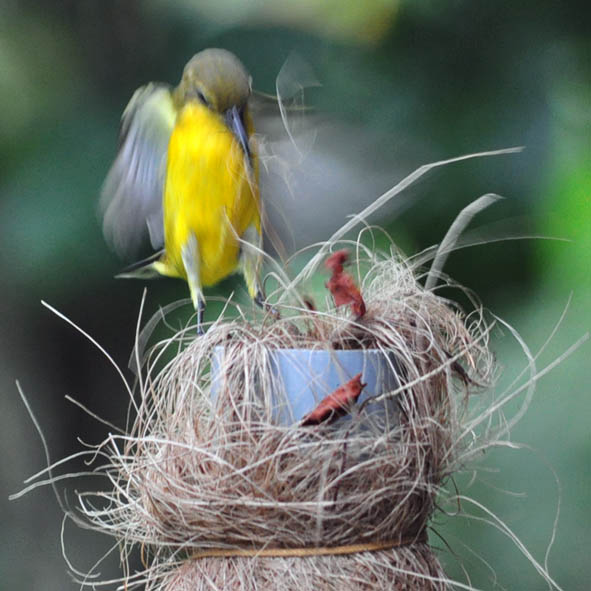
The Olive-backed Sunbird (Nectarina jugularis) or Kelichap Bukit in Malay are very bold birds that freely build nests in my garden. One day while photographing some flowers I heard rustlings nearby. As I moved towards the source of the sound, I discovered the mystery of my denuded plastic stake used as a support for the Philodendron Imbe. The covering of coconut fibres was frayed.
 
A female sunbird was so absorbed at plucking the fibres that she was totally oblivious of my presence. In fact I was only about eight feet away from her. The upperpart is dull olive-green while the underpart is all yellow.


With flapping wings, it jerked some fibres out of the stake with ...


its long, slender, decurved bill.

It then flew off and


landed on another part of the stake.


to tug at more fibres.

After more inspection and pecking, it flew off.  I suspect that it would come back later to pick up the fibres that it dropped.


 These unstaked Philodendron Imbe simply just sprawled invasively all over the flower bed, killing off the competition from other flowering plants.

 
The male sunbird appeared contented to leave nest-building to the female [as in humans, always so good at multi-tasking ;)]. Here, it's perched on a Thunbergia Grandiflora vine to take in the garden view. 


Thunbergia Grandiflora

 
The forehead, throat and upper breast is metallic blue-black contrasting with bright yellow underparts. The upperpart is dull olive green just like the females. The feet are jet-black.

 
The male Olive-backed Sunbird is more colourful than the female which does not have the metallic blue colouring.

 
The orange-red semi-double Hibiscus rosa sinensis.

This clump of Cyrtostachys renda (Lipstick Palm) form the backdrop for many bird activities. it supports the vine and also provide palm fruits for the bird's consumption


The base of the clump of Lipstick Palm sustains the growth of many Davalia denticulata (Corsage ferns).


LinkWithin

Related Posts Plugin for WordPress, Blogger...