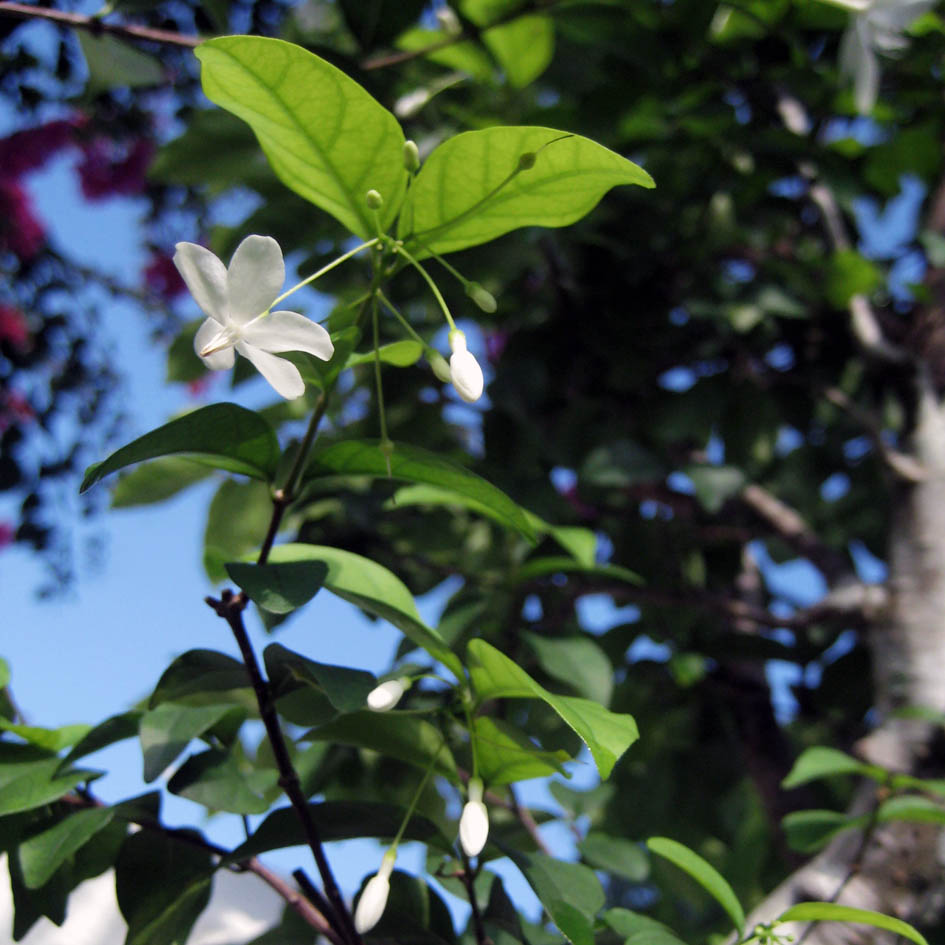
Showing posts with label Wrightia Religiosa (Water Jasmine). Show all posts

Wednesday, April 2, 2014

Strelitzia reginae - Bird of Paradise

Strelitzia reginae (Bird of Paradise) is very popular as an ornamental plant. This clump was bought during my working trip to Cameron Highlands. I was there to capture some images of our outreach programme to the rural areas for the production of the Ministry's coffee table book.


I was thorougly enchanted by the flowers. They stand above the foliage at the tips of long stalks. The hard, beak-like sheath from which the flower emerges is termed the spathe. This is perpendicular to the stem, which gives it the appearance of a bird's head and beak. It makes a sturdy perch for the sunbirds.  It was rather expensive but I just can't leave the nursery without it.

The flowers, which emerge one at a time from the spathe, consist of three brilliant orange sepals and three purplish-blue petals. Two of the blue petals are joined together to form an arrow-like structure. When the sunbirds sit to drink the nectar, the petals open to spill pollen over their feet, thus aiding in pollination.

The plant grows to about 6 feet tall, with large, strong leaves produced on petioles up to 3 feet long. The leaves are evergreen and thick. In the background are the white flowers of Wrightia Religiosa (Water Jasmine).

The flowers last about a fortnight before it looked like this.


While transporting the clump to my new house, I saw this pupa on the undrside of one of the long leaf blade. I then tied two leaf blades loosely together to protect it. Unfortunately when I reached my destination, it was no where to be found. I hope it can complete its life cycle.


Friday, January 18, 2013

Wrightia Religiosa - Water Jasmine

I have too many Wrightia religiosa (Water Jasmine) bushes in my garden. Some are in containers while others are sprouting like weeds in the grounds. Suckers from established plants have also invaded adjacent areas.  I've pruned off many of these volunteer plants but they soon re-appeared with a vengeance. 
 
A black-white butterfly of unknown ID fluttered amongst the scented single-petaled flowers. It has lovely black-white pattern on the wings with some yellow on the head and thorax. 


It then fluttered to a braided planted in a container. Many stems are twined together in a basket weave pattern forming a cage.
 
The flowers here are of the double-petaled variety.


As the flowers of Wrightia religiosa face downwards, butterflies have to be upside down to get at the nectar.

 The abdomen is studded with black dots and end with a splotch of yellow at the posterior end.

 
However some of the flowers are single-petaled. The soft apple-green hue is due to the proximity of the leaves to the lens, the butterfly being in the centre of the bush.
Other than the antennae and eyes the head together with the proboscis is totally yellow. 


"The butterfly is a flying flower,
The flower a tethered butterfly"

~Ponce Denis Écouchard Lebrun


 These are single-petaled flowers.


 A split seed pod with feathery seeds ready for flight with a strong breeze or to be washed down with the pouring rain.


 Against the azure-blue sky.

Note: This moth should be a member of the Nyctemera genus as determined by Horace Tan of Butterflies of Singapore


LinkWithin

Related Posts Plugin for WordPress, Blogger...