Showing posts with label Bauhenia kockiana. Show all posts

Thursday, January 21, 2016

Obssession of Carpenter Bees

Carpenter bees whizzing past is a common sighting in my garden. They flew by fast and furious, buzzing loudly at the same time. When there is a handful of them buzzing around, the drone can be quite intimidating. Sometimes I have to duck when they buzzed just inches away from my head.


This one flew purposely towards the object of its desire ...


a blushing red Hibiscus rosasinensis bud.

 
Eventually it landed on the coveted Hibiscus bud.


Bud hugging is a favourite past time.


 In the background are the orange clusters of Bauhenia kokiana. 
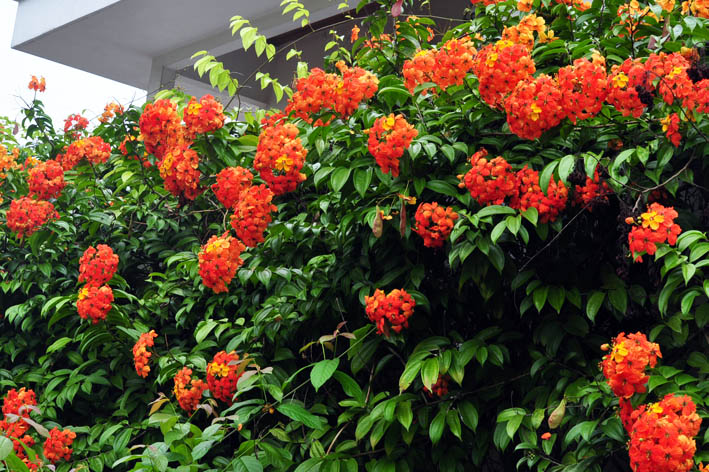

They bloomed profusely for most times of the year.


It continued doing so for all eternity, flying off for a brief interlude and back again to the same bud. I think they could be suffering from a psychological condition, OCD (Obsessive Compulsive Disorder).

Under the overhead sun, the dark wings glimmered with hues of blue, purple  and tinges of red. The body is absolutely jet black.


Every now and then, it flaps its parchment-thin wings rapidly ...

 
in readiness for take off to God knows where.

A Hibiscus in full bloom.

 
Another bee was sighted on a similar flight pilgrimage to its object of obsession.

It landed on the bud and perched on it possessively.


I always wonder why they do not fancy fully matured blooms such as this but instead chose the buds. There were no signs of pollen or nectar gathering.


A seed pod


Wednesday, September 3, 2014

A Nesting Spotted Dove

The Spotted Doves (Spilopelia chinensis) often nest in my garden. They are quite bold and are not too shy of human presence. 

I took a ladder and clambered to the top to take this photo. This one sat serenely atop its nest and simply ignored my intrusion. 


I was actually very close to it. The bird was merely inches away from my lens.


These were her two precious eggs - pristine white.

This is how the Spotted Dove accessed its nest, its tail a tell-tale sign of its domestic activities.


This is the Juniperus chinensis where the nest was lodged.


Bauhenia kockiana vine tends to be invasive. I kept it under control with constant pruning and shaping.


Nearby is this elegant casuarina tree is around twenty years old. Birds of all varieties love to perch on its branches.


Saturday, May 31, 2014

Preening Bulbuls on Bauhenia kockiana

Yellow Vented Bulbul (Pycnonotus goiavier) are one of my favourite birds. I love the spiked hair tufts on top of their heads. They are much bigger than sunbirds and almost the size of doves.

The throat and underparts are mostly white with an attractive yellow patch at the base of tail. This Bulbul was perched on the vine of Bauhenia kockiana.


Flowers of the Bauhenia kockiana which trailed along the outer edge of the RC rain gutter.


This Bulbul has completed one part of its grooming routine and ...


... pause for a break.


Intertwining of two vines.

 
A cluster of Bauhenia kockiana buds and flowers.


It then embarked on a second cycle of preening. Somehow it only groomed the right wing and totally ignored the left wing.


This vine extends to the back of the house too.


Friday, May 23, 2014

Lyssa Zampa - Tropical Swallowtail Moth

Lyssa zampa is a large moth, measuring around 6 in across. It is also known as the Tropical Swallowtail Moth due to its long trailing hindwings. This moth presents in shades of chocolate brown varying from light to dark. A distinctive oblique white stripe runs across both the fore and hind wings giving it a striking 'V' pattern.

 
A large moth, Lyssa zampa appeared in my garden with a torn right forewing. It perched on the vine of Bauhenia kockiana (Rangoon creeper) for some respite from its misadventures.


Masses of Bauhenia kockiana along the vine add much hot and vibrant colours to the garden.

 
 Pendulous branches carry terminal inflorescences. A single seed pod forms on one of the older clusters.

   A Lyssa zampa moth made a  surprise visit to our garden. Later in the evening it perched on the wall of the outdoor/ Asian kitchen.


The eyes generally appear black as in the previous photo (also the first and second ones too) but may manifest as an iridescent red globe from certain angles and under bright lighting.

 
The anterior edge of the forewings has an interesting band of black and white zebra hide markings. As with most moths a luxuriant coat of fur covers its back.

 
The hind wings are elongated like those of swallows ...

 and end in white.


 Cuttings from The Star, Updated on 5 June 2014:


LinkWithin

Related Posts Plugin for WordPress, Blogger...