Showing posts with label Catharanthus roseus. Show all posts

Wednesday, March 26, 2014

Madagascar Periwinkle - Butterflies' Favourite

 Given the right environment, Catharanthus roseus, commonly known as  Madagascar periwinkle can grow with wild abandon. 

 
 It is very grateful for life's little mercies and rewards us with numerous blooms.

 
Bright or filtered sunlight with lots of water is an absolute necessity.

Even a small amount of fertiliser will get the gardener amply rewarded with a profusion of blooms.

The blooms can be so heavy that they tumble down under its own weight in a planter box.


They are self-seeding, sprouting easily from the ground or wherever the seeds land.

 Where the seeds land it is home, thriving in any nook and cranny. Here they sprouted from the grouting between the bricks of a planter box.
 
^^^^^^^^

The periwinkle is a veritable magnet for the many colourful winged-beauties in the garden. They flutter over in droves, happily alighting over leaves and flowers. 
The Painted Jezebel (Delias hyparete metarete) is a frequent visitor to my periwinkle plants.

 
The Common Lime (Papilio demoleus malayanus) flits between my citrus trees (calamansi) and the periwinkles for a varied diet.

This skipper butterfly of the family Hesperiidae sank its thick proboscis into the deep recesses ...

to draw out the sweet nectar.

Another one was clearly intoxicated from this fountain of sweetness.

 
The Peablue butterfly (Lampides boeticus), is another type of flutter-in guest.  

One with broken wings but not broken spirit, continued to eye the nectar in the flowers.

 
Some left their succulent offsprings, the caterpillars behind to their own devices. 

 
With their voracious apetities, they become plump little green sausages in no time. It doesn't care much about the flowers as the leaves are the coveted food.

Sometimes a bit of acrobatics is involved for munching the leaves. A nice soft leaf-mat to lie on makes the job much easier.
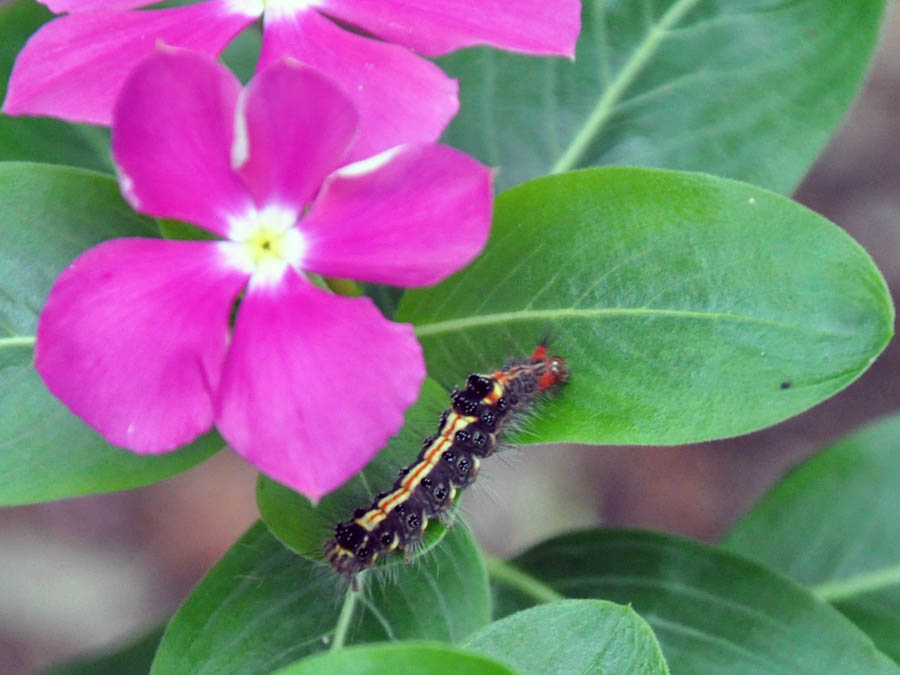
 
This little hairy caterpillar is a fast trekker in his forage for food.

^^^^^^^^

  Usually the blooms present in clusters of two or three in various shades of pink, purple and red.
 
the reds with white centre
 
 The ubiquitous magenta with white centre.

sweet baby pink with white centre

mauve with white centre

light pink with crimson centre

salmon with pink centre

 
A hanging pot as viewed from my kitchen window.

I'm have been following the latest updates on the fate of the missing MAS plane, MH370. As there is no hard physical evidence (retrieved) to link it to a possible crash in the Indian Ocean, closure will not be absolutely complete for family members and friends of the passengers and crew. Our prayers are still with them and we empathise strongly with their predicament. 


Tuesday, February 26, 2013

Meanies and Crawlies on my Calamansi

Potted Calamansi plants (Citrofortunella microcarpa, limau kasturi in the Malay language) are ubiquitous during the celebration of the Chinese Spring Festival. I have several pots left from previous years. My calamansi plants have a magnetic appeal for all sorts of critters.
The caterpillar of the Lime butterfly (Papilio demoleus malayanus) crawled all over the plant in search of the juiciest leaves to feed on. It masticated voraciously as evidenced by the jagged edges of gnawed leaves and its droppings. It even had the audacity to chill out on my prime fruits besides casually depositing its droppings. The outcome of which is a very suggestive pose. Honest, I didn't staged this scene. Actually this particular scene started me on the thread of this post.

This newly emerged Lime butterfly, settled on a leaf of the hedge (Baphia nitida) to dry out and warm up. 

Here under the bright morning sunshine it flapped its wings up and down with slow incisive motions. I can almost feel it purring with pleasure.

While strutting its stuff, its underside was displayed in all its 'batik' glory.


A Green Shield Bug with mean beady eyes laid seige on its territorial turf; leaves that had yellowed and had seen better days.
 
However it then turned around to shrewdly contemplate its next course of action ...


 on moving to greener pastures.


 Somewhere else on the shrub, a tiny ladybug quietly tried to navigate its way between the leaves.


This Pied Shieldbug (Sehirus bicolor) is the new kid on the block, but had snugly ensconsed itself in lush lime foliage.

It also wanted to stake its claim on a piece of prime property and had chosen this promising green citrus, hugging it covetously.


On the other hand, ants do not partake of foliage or fruits, instead they have their hands full gathering nectar and pollen from the Calamansi flowers. 

The larvae of some citrus Leafminers left evidence of their nefarious activities on the undersurfaces of some lime leaves.


This plant is a legacy from last Chinese New Year's purchase of ornamental plants. My Calamansi plants have served me well. I harvest the fruits almost daily to zest up my juices, cocktails and sambal belacan. It is most flavourful as its fragrance and aroma is unique unlike Citrus aurantifolia (Limau nipis in Malay) which is just plain sour.


A platter of oranges, calamansi and bananas ready to be blended. As many creepy crawlies have a run all over the plant and fruits, I scrub the fruits thoroughly with soap before using.


The fruit platter makes five glasses of refreshing fruit juices and is loaded with oodles of vitamin C. As I sipped the juices, I can feel its goodness coursing through me :)


LinkWithin

Related Posts Plugin for WordPress, Blogger...