Showing posts with label Moth. Show all posts

Friday, January 18, 2013

Wrightia Religiosa - Water Jasmine

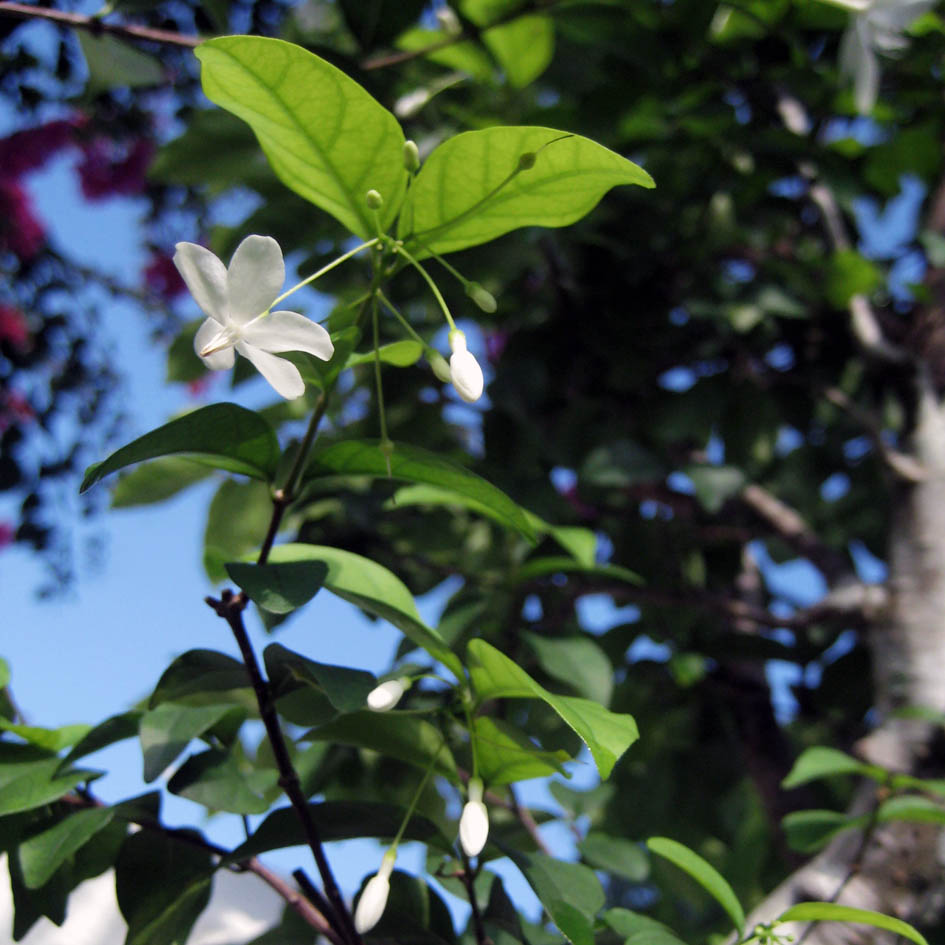
I have too many Wrightia religiosa (Water Jasmine) bushes in my garden. Some are in containers while others are sprouting like weeds in the grounds. Suckers from established plants have also invaded adjacent areas.  I've pruned off many of these volunteer plants but they soon re-appeared with a vengeance. 
 
A black-white butterfly of unknown ID fluttered amongst the scented single-petaled flowers. It has lovely black-white pattern on the wings with some yellow on the head and thorax. 


It then fluttered to a braided planted in a container. Many stems are twined together in a basket weave pattern forming a cage.
 
The flowers here are of the double-petaled variety.


As the flowers of Wrightia religiosa face downwards, butterflies have to be upside down to get at the nectar.

 The abdomen is studded with black dots and end with a splotch of yellow at the posterior end.

 
However some of the flowers are single-petaled. The soft apple-green hue is due to the proximity of the leaves to the lens, the butterfly being in the centre of the bush.
Other than the antennae and eyes the head together with the proboscis is totally yellow. 


"The butterfly is a flying flower,
The flower a tethered butterfly"

~Ponce Denis Écouchard Lebrun


 These are single-petaled flowers.


 A split seed pod with feathery seeds ready for flight with a strong breeze or to be washed down with the pouring rain.


 Against the azure-blue sky.

Note: This moth should be a member of the Nyctemera genus as determined by Horace Tan of Butterflies of Singapore


Tuesday, December 25, 2012

It's Christmas!

This year I decided to use my two-year-old Norfolk Island Pine as a live Christmas tree. I bought this 8 inch tall plant from Ikea, had it planted in a container and now it has about 8 tiers. It is not very tall but I thought that it should suffice for this year.


 Well, next year it will be different as I planned to be more diligent in applying nutrients and molly coddle it for the next 12 months.
 
This plain, chocolatey moth flew and rested on a leaf next the colourful tinsels.

It scrambled around for a while and then laid motionless, which to all appearances has become part of the tree ornaments.


Santa visited this bird nest of three baby birds.

 
Tasha was also enomoured of the ornamented tree.


Tasha getting into the festive mood by

 
donning a diamante tiara.
 
This huge wooden dog door stopper present a merry welcome to guests.
 
This Dracaena draco houseplant was tarted up for the occasion.

Santa teddies on a rope of acrylic garlic.


Dried home-grown bamboo stems are used as props for these ornaments, some of which are decades old.


Some concrete garden animals at the base of bamboo props.

Ornaments on pussy willows from last year's Spring Festival.


The tall one at Berjaya Time Square.


Wishing you a joyous Christmas!


Thursday, October 25, 2012

A Pink-throated Hibiscus

This is one of those smaller old-fashioned Hibiscus unlike the large and gorgeous hybrids that we see nowadays. However, it is not without its charm. The white petals are streaked with fuchsia-pink lines which merge towards the tubular part giving it a pink throat. 
The markings serve as a good guide for pollinators as to the sweet treasure within.

In Hibiscus the numerous stamens comprising filaments and anthers are carried on a long upright staminal tube which also encloses the style.

 The style branch into five, each carrying a stigma at its end. The stigmas look like orange pom-poms.


"In the end, life lived to its fullest
is its own Ultimate Gift" - Jim Stovall


The anthers have popped releasing the fine pollens.

A top view of the outstanding reproductive part of the flower.

This long protrusion of anthers and stigma cast a shadow under the morning sun.


After the shower, the flower is still fresh for the picking.

A Common Five Ring butterfly (Ypthima baldus newboldi) perched daintily on a bamboo stem which is used to stake the Hibiscus plant.


This greyish brown butterfly has a single large ring (ocellus) on the forewings while there are five ocellus on the hindwings. The last pair is counted as one. The ocellus or eyespots are black enclosed by yellow rings. The eyes are grey, matching the wing colours.


A Hibiscus leaf is the prefered landing perch of this brown moth. It has dark brown patches strewned in wavy lines across its wings. Unlike butterflies the antennae of moths do not end in clubs. As they are nocturnal, moths are more furry so as to counter the lower temperatures at night. Note that a main distinguishing feature of moths is that they rest with the wings flat whereas butterflies have their wings folded upwards. 

Posted from Cork, Ireland (I've only a few days left from my one-month sojourn in Ireland).

LinkWithin

Related Posts Plugin for WordPress, Blogger...