Showing posts with label Eurasian Tree Sparrow (Passer montanus). Show all posts

Friday, November 15, 2013

Malvaviscus arboreus - Turk's Cap Hibiscus

Malvaviscus arboreus is known as Turk's Cap or Lipstick Hibiscus. The bright red flowers are showy and about 1 inch or more long. Its flowers do not open fully or flare back like the Hibiscus, hence the alternative moniker, 'Sleeping Hibiscus'.


 The petals are overlapping and swirl around a protruding column of pistil and stamens.

New buds can be seen in clusters behind every flower.


A new bud without the cheeky 'tongue'.

 
The bright red flowers last for several days.


Its prolific blooming habit helps attract birds, butterflies and other critters.
 
To be surrounded by so many nectar fountains ... definitely spoilt for choice.

A female sunbird sipped delicately from the base of the flower.

A drop of nectar can be seen at the tip of its curved beak.


With sated appetite, it took a breather and the view too.


Sparrows are frequent visitors too.

Even when there no nectar is available, they love to perch on the branches.

 
The other half of this pair have trouble keeping up ...


and appeared to be shrieked at by its impatient sparrow partner


Later the pair had some quality time together, though it didn't seem to be too cosy, after all the shrieking.


Sunday, March 3, 2013

An Eurasian Tree Sparrow Scratches an Itch

The Eurasian Tree Sparrow (Passer montanus) is as ubiquitous as ever in Malaysian gardens, including mine. Initially, I did not want to shoot them as they seem so drab in their brown and black. As there were so many around and created a ruckus all day long, it was inevitable that they eventually got to be photographed.
 
On close-ups sparrows are not just brown with darker patches.


Immediately below its black bill, a distinctive black marking is seen on its throat which tapers towards the upper chest. On each side of its white cheek, a black patch distingusihes it from the house sparrow.  Its belly is white or of lighter hue.

The crown is reddish-brown.  The upper part of the body is brown with black markings all over, particularly near the tips of feathers which are trimmed with a an edge of white. 


A favourite hang-out for them is my red Hibiscus bush where they can bask in the filtered sunlight through the canopy of leaves above. 


Another favourite hang-out is the top of the perimeter brick fencing in the garden.


This one was seen busy pecking away at its underside. I thought it was preening, but on observation, it could also be scratching an itch.

It then turned to the right side to continue scratching. The more it scratched, the more engrossed it became.


Every now and then in between preening, it moves towards the base of the tail, presumably to distribute a special oil that is secreted from a gland. This oil helps to give a sheen to its feathers and to keep it in good condition.  

After a bout of this activity, it seems to be absolutely relieved.

But then an itch occurred around its throat area which is impossible to peck at with its beak. This was simply solved by kicking its feet up to scratch the itch.

Its long toe-nails seem to be suited precisely for the job.

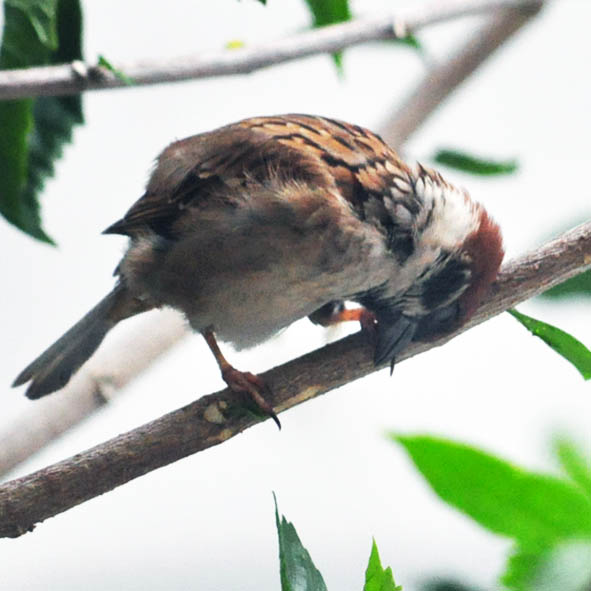
Now, the itch has spread to its crown. So, rubbing the head on the rough bark should do the job nicely.


That felt so good! After a short while,
  
the underside of the wings too needs some working on too.

Now the back too needs to be scratched ...

Here it sat, nicely preened and fluffed up. I strongly felt like dusting it with some talcum powder to finish the job.


LinkWithin

Related Posts Plugin for WordPress, Blogger...