Showing posts with label Carpenter bee. Show all posts

Thursday, January 21, 2016

Obssession of Carpenter Bees

Carpenter bees whizzing past is a common sighting in my garden. They flew by fast and furious, buzzing loudly at the same time. When there is a handful of them buzzing around, the drone can be quite intimidating. Sometimes I have to duck when they buzzed just inches away from my head.


This one flew purposely towards the object of its desire ...


a blushing red Hibiscus rosasinensis bud.

 
Eventually it landed on the coveted Hibiscus bud.


Bud hugging is a favourite past time.


 In the background are the orange clusters of Bauhenia kokiana. 
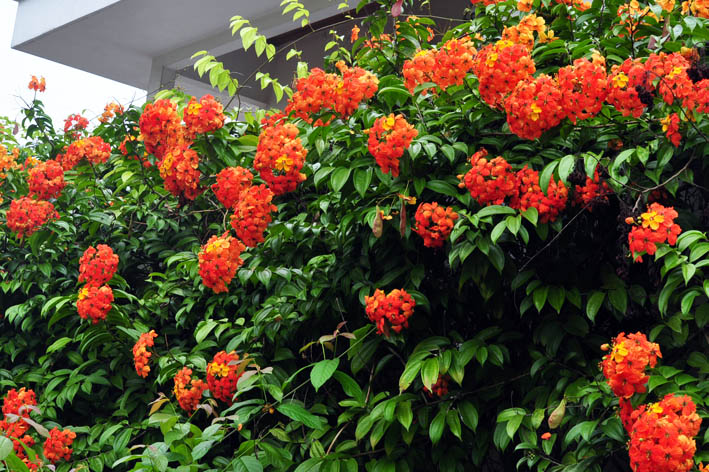

They bloomed profusely for most times of the year.


It continued doing so for all eternity, flying off for a brief interlude and back again to the same bud. I think they could be suffering from a psychological condition, OCD (Obsessive Compulsive Disorder).

Under the overhead sun, the dark wings glimmered with hues of blue, purple  and tinges of red. The body is absolutely jet black.


Every now and then, it flaps its parchment-thin wings rapidly ...

 
in readiness for take off to God knows where.

A Hibiscus in full bloom.

 
Another bee was sighted on a similar flight pilgrimage to its object of obsession.

It landed on the bud and perched on it possessively.


I always wonder why they do not fancy fully matured blooms such as this but instead chose the buds. There were no signs of pollen or nectar gathering.


A seed pod


Tuesday, April 15, 2014

Thunbergia Grandiflora - A Sky Blue Curtain

I have this vine of Thunbergia Grandiflora and Tristellateia australasiae (Maiden's jealousy) planted on the right side of the house. Both were trained to clamber up the wall and cascade down the front of the car porch.


The Tristellateia australasiae vine is slower growing and just managed to reached the top of the porch. Its canary yellow flowers can be seen peeking out on the right side.


 This photo was shot in the late afternoon, so a number of blooms have wilted under the searing heat of the sun.


Over time this curtain gradually grew thick and lush.


The sky-blue flowers are the favourites of Carpenter bees.


A carpenter bee buzzes in without much ceremony.

  Thunbergia blooms on vine intertwined merrily with a tecoma stans shrub.


The flaming red spikes of Alpinia purpurata (Red ginger torch) added a dollop of dramatic pigments to an otherwise pastel curtain of sky-blue flowers.


Ants at a gathering on the underside of the leaf.


Come dusk, it was chow-down time for this scavenger snail.


A vessel of freshly-plucked flowers make for a welcoming eye candy.


Friday, March 14, 2014

The Flamboyant Bougainvillea 'Mrs Eva'

It is a witheringly hot, searing season with rainless days for almost two months now.  Thankfully there's enough stored water in the huge roof-top tanks to drench the plants once in a while. However, my bougainvilleas are not complaining. In actual fact they flourish while we fumed through heavy perspiration and pray for the sky to open up.


The almost leafless Bougainvillea 'Mrs Eva' in full glory. The green leaves are those of the orange Bauhenia kockiana.


This is the whole plant at the height of flowering.


The young bracts are slowly forming. The white-pink-red terminal flowers of Quisqualis indica (Rangoon creeper) also claim some vertical space in this massive  floral display.
 
Another view at another time.
 

A carpenter bee clutcthing on to a faded bract.


It was rather late in the evening, thus this blurred image of a hummingbird moth with its proboscis dipped into nectar.


At dusk, dragonflies returned to repose on trimmed stems and branches.


A container-planted B. Mrs Eva with a periwinkle sprouting from its trunk. A random seed found its niche in its crevice and grew as a parasite. The red flowers of Carphalea kirondron and the yellow-orange Codiaeum variegatum (Variegated Croton) add layers of colours.


Wednesday, February 19, 2014

Red Hot Double-petaled Hibiscus

Double-petaled Hibiscus has all the beauty of the single-petaled ones but double the charm. It's the tropics version of roses minus the nasty thorns and of course the fragrance.
This double-petaled variety can measured up to six inches in diameter.


A Carpenter bee perched on a bud to soak in the sun, flying off and then returning. They can do this for the entire day. From my observation they do not gather from Hibiscus.

A damselfly emulates the carpenter bee in this bud-hugging activity.
The flower bud of a double petal Hibiscus.

The bud develops while a clueless ant scrambled over it being too early for the party.


The maturing bloom, just before it unfurl its petals.

In double-petaled Hibiscus, the stigma and anthers are at the same level while part of the seminal tube is fused to the petals.


Staminal tube of single-petaled Hibiscus
In single-petaled Hibiscus, the stamens and the style share the same staminal tube with the stigma held aloft. This way the chances of reducing self-pollination is better. The pollen grains are ready for harvesting by unsuspecting insects looking for nectar. An unidentified insect huddled up.


This is older variety of double-petaled Hibiscus is often refered to as the 'kampung' type which means village in Malay.

The flowers are smaller, measuring about two-three inches wide.


At this early stage, the flower petals are firm and rosette-like.


When in full bloom, the petals appear papery.


 The flowers are small and globular and look almost like pom-poms.

The next day the blooms are suspended by a thin thread which are the seminal tubes.

 Unfortunately, they can be prone to infestation by aphids and mealy bugs.

Hibiscus on old silver trinket box from Java, Indonesia.
(From my sister's antique silver collection)


LinkWithin

Related Posts Plugin for WordPress, Blogger...