Sunday, August 19, 2012

Pseuderanthemum reticulatum - the insect attractant

The flowers of Pseuderanthemum reticulatum are borne on upright spikes. The 4-petaled white flower has a magenta throat, spreading outwards into speckles and dots.
A lovely spike of delicate flowers interspersed with buds which are ready to pop over the next few days.

Pseuderanthemum reticulatum is a fuss-free plant. Young leaves are yellowish green, becoming darker green with yellow veins or reticulations as they age.

It can be grown as a border plant to provide an effective and attractive screen.

 
A flower fly landed on this petal to contemplate the goodies within.


An ant joined in the exploration of this flower.

A golden drop of nectar becomes a sweet source of sustennance for the day.


This pearl of a drop can be indulged in a different setting just by hopping on to the next petal.

Traces of left-over nectar lead to frenzied feeding from a bunch of ants. They scrambled over each other in pursuit of the sweetness.


A female Jacintha Eggfly (Hypolimnas bolina jacintha) fluttered by and perched on the flower spike.
She immediately started on plumbing the deep recesses for the coveted delicious liquid.

 
This spider made a sudden appearance on a young flower spike.


It smelt the presence of grub and is bidding time to switch on to predator mode.

 
A soldier beetle is waiting on the underside of a leaf, also bidding its time.

With the breaking of dawn, this common garden snail is casting around for a safe place to retire from the onslaught of the harsh sun.


It did a long stretch upwards to reach the leaf above.

And then its a heave-up to position the whole foot on the leaf.

In this upside-down position on the underside of a leaf, it rested for the entire day.

While removing these unsightly 'holey' leaves, I came across this snail stuck onto the underside of a leaf.

A floral spike from the garden is used to brighthen up my kitchen window sill. This small vase has been with the family for more than five decades.

Friday, August 10, 2012

The Bat Knight Rises - Combat with Twig-worms


The GRACIOUS HOST
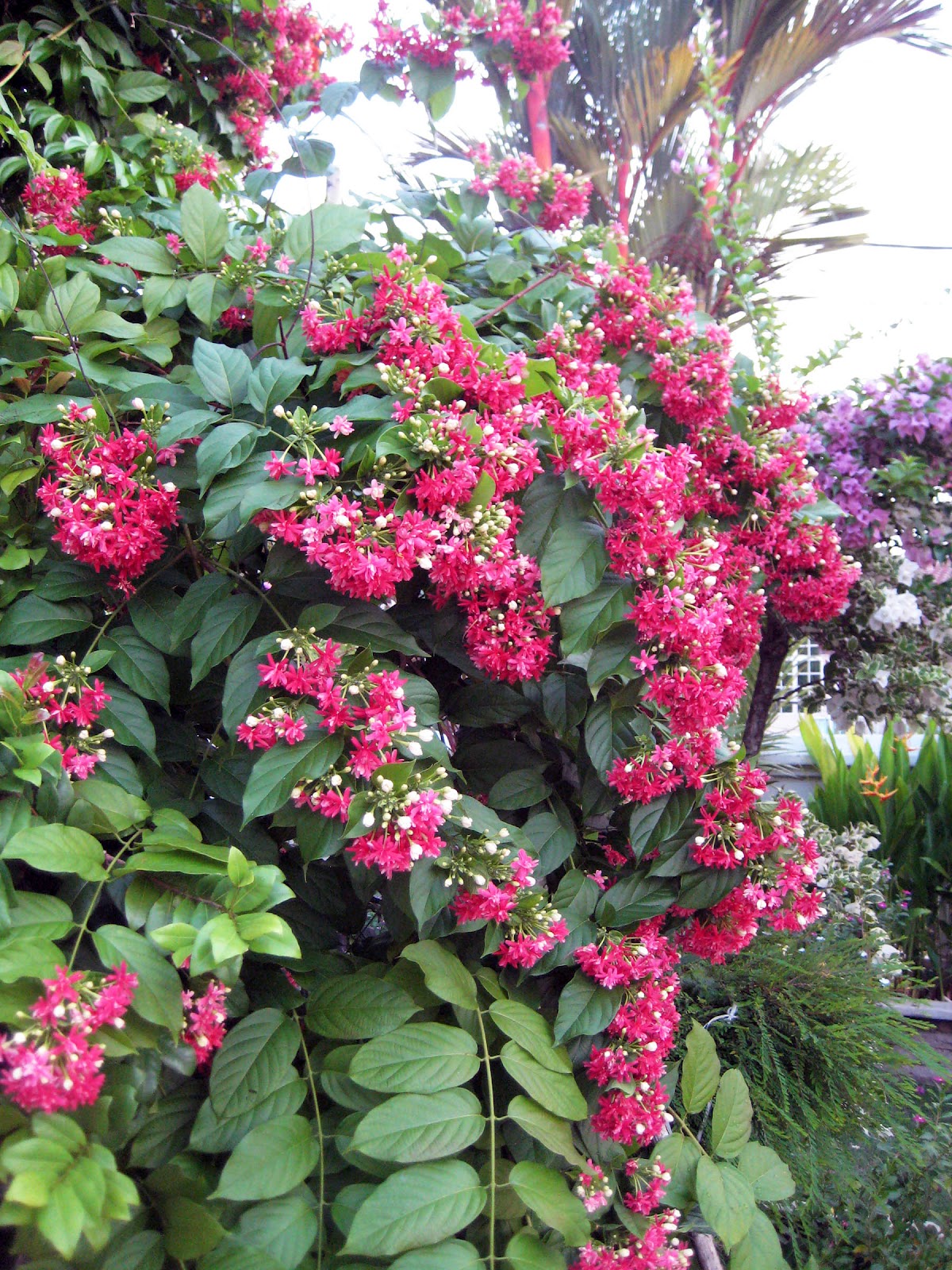
I adore the flowers of Quisqualis indica with its light fruity fragrance. Thus a few Q. indica vines can be seen twining itself up in my garden. 
A fully matured Quisqualis indica vine reaching up to the balcony. This is the 'Mother vine'.
A sucker taken from the 'mother' vine has grown vigorously to scramble more than 20 ft up to embrace the balcony.
 Another sucker has been trained into a young standard with support from the wall. This is its maiden blooming, thus the clusters are considerably smaller.

They flower continously and its fragrance pervades the whole garden, perfuming it. Actually I've always harbour the hope of having a perfumed garden. Towards that end I've planted an array of plants with fragrant blooms.
The single petal variety is more common than ...
the double petal type.
The fragrance of the 'double' is spicer and heavier and could be cloying. I personally prefer that of the 'single'. Both are gorgeous when in full bloom.

THE BATS
This vines are popular hanging-out grounds for various faunas including bats, caterpillars, bees, snails and others. 
While pruning one of the vines, I came across a bat suspended from one of the branches.
When I moved nearer, it turned its head down to scrutinise me with unblinking jet-black eyes. We eyeballed each other for several moments before it decided to take flight.

THE MENACE
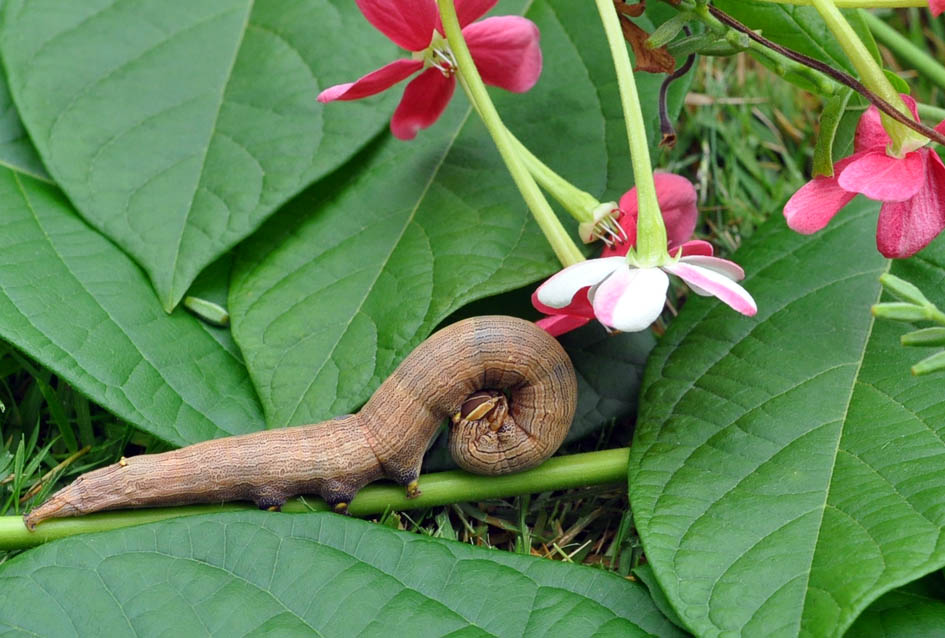
It is good gardening practice to prune after every flowering season to encourage new growth and flowering. While clearing out the pruned vines, I came across this stiff and menacing twigworm stretched out immobile along the stem.
It could be trying to "play dead". I turned it over, ...

and it immediately coiled its head part very tightly. After what seemed like an eternity of being in this coiled up position,
it decided to creep forward in this arched position as worms normally do.
It then stretched itself out along another section of the stem, 

and remained rod-stiff for all eternity. As there was no love lost between us, it was swiftly disposed off together with the rest of its ilk. I get goosebumps just looking at it.

Both bat and twig-worms are found on the same plant. I just wonder whether this twig-worm menace can be mitigated by the presence of bats. Hopefully it is not a situation of cozy co-existence.

FRUITS OF LABOUR
Pruned Q. indica flowers are not thrown away but brought indoors for further enjoyment of their wonderful fruity fragrance .
 
A simple arrangement where the blooms are just plonked on a giant clam shell.

TRUE LABOUR
Profusion of blooms means there is work to be done when the show is over. Usually the blooms can last over a week and even  longer if there is no heavy shower. These flowers are not discarded as they make good mulching material.
The aftermath of a shower.
Note: The title of this post is a play on the latest batman movie, 'The Dark Knight Rises' starring Christian Bale and directed by Christopher Nolan.

Monday, July 30, 2012

The Tall and Short Ruellias

The Ruellias are one my favourite perennials. The 'elegans' are the leggy ones while the 'brittoniana' are shorties. Both bloom almost daily and add so much gaiety to any garden.

Ruellia elegans 
This is the taller version. They tend to be floppy and need some staking while some of the branches can be allowed to drape elegantly over a tall pot for a striking visual impact. 
Close-up of Ruellia elegans 

 
and bud.

They bloom in clusters.

 They can be planted in the ground or in containers. Here they are planted next to a row of Baphia nitida hedge.

These undemanding plants thrive without much care.

They flourish despite neglect. In fact this clump was unceremoniously extruded from its pot and dumped with its naked rootball on to the ground, yet it is thriving. 

What they cannot do without in our hot tropical clime is water. Copious amount is needed to slake their thirst otherwise they would easily wilt. However, as soon as they get a through drenching, recovery is rapid in no time and they look none the worse for wear.  

Propagation is by stem cuttings or root clump division.


Ruellia brittoniana
These are the dwarf species. I have them in three hues; pink, lavender and white. Propagation is by root clump division and from seeds. In fact they self-sow freely and in no time, baby plants are seen everywhere.
delicate pink

lavender

bridal white

This plant share the same container with Philondendron xanadu and ivy.

A pot of Ruellias of different hues with the white ones on the other side.


Snails are very fond of their leaves and make lovely meals out of them. After their chow down, the plants are reduced to mere stalks, being completely denuded of foliage. In frustration, I potted them thinking that heights might deterred those pesky molluscs but alas no heights are too lofty for them. I've seen them scaled up to the second level of the house.

With such voracious apetites, the snails are on a ...

continuous chow down.

Floating dwarf Ruellias with teeny-weeny ivy leaves.

Saturday, July 21, 2012

Allamanda - violacea and cathartica

I've planted the violacea and cathartica versions of Allamanda from cuttings. Both types root easily. The former has thicker petals than the latter. All parts of the plant when removed before its time will bleed a sticky and milky-white sap.
The A. violacea is a real climber with more sturdy, woody stems and is now about 10 feet high.
It grows vigorously and looks set to scale even greater heights. However its height is limited to the 12-foot bamboo stake used.
The bright canary yellow A. cathartica is
a real attention grabber.
This insect moved into the inner recesses of the bloom and has trouble making an exit. 
Masses of bright cheery trumpet-like flowers are produced year long. Growing in between are Nerium Oleander and Heliconium rostrata.
Flower buds are waiting impatiently to burst into blooms.
 The leaves of the A. violacea are of paler green and covered with fine hairs while those of A.cathartica (smaller piece, in front) are smooth with a sheen.


I can't determine whether these tiny pellets on this Allamanda cathartica leaf blade are eggs or seeds. 
A solitary A. violacea among a bunch of A. cathartica in a clam shell.


LinkWithin

Related Posts Plugin for WordPress, Blogger...