Friday, February 1, 2013

Churning the Ocean of Milk - A Tribute to the Year of the Snake

To commerate the year of the snake, I dug into my archive of photos from my travels. I've not been to Bangkok for a while, so in June 2011 after  passing through Immigration at Suvarnabhumi Airport, I was pleasantly surprised by a huge colourful scene of 'The Churning of the Ocean of Milk'. This scene has its roots in Hinduism and is found in the ancient Purana scriptures. Due to a curse from an offended sage, the Devas (demi-gods) lost their divine powers and thus sought to regain it by getting hold of amrita, the nectar of immortality. They came up with an elaborate scheme which involved forging an alliance with the Asuras (Demons) to churn up the ocean of milk in order to retrieve it. For this purpose, they used Vasuki, the seven-headed serpent (cobra) as a churning rope by coiling it around Mount Mandara as a pivot and tugged at it from both ends.

The section of the serpent, Vasuki, with the seven heads ...

 
was held by the Asuras (demons).

The Devas were well-advised by Vishnu not to take this end. 

 
The mid-section of Vasuki was coiled round Mount Mandara which acted as a pivot. The resulting force from the churning was so great that eventually Mt Mondara broke off and sank. Vishnu through his avatar, Kurma the tortoise bore up the mountain.

On the other side, the tail end of Vasuki ...

was held by the Devas which was a smart move as they avoided the poisonous fumes from the seven roaring mouths of Vasuki.


Eventually a total of 14 precious objects and treasures were retrieved. The culmination was the nectar of immortality which was delivered by Dhanvantari, the physician of the Gods. As the nectar was coveted by both parties, a fracas broke out and it ended up in the hands of the Asuras.

Vishnu then saved the situation by turning into Mohini the enchantress. Through her shenanigans she managed to snatch it away from them and fed it to the Devas who then regained their divine powers of immortality.


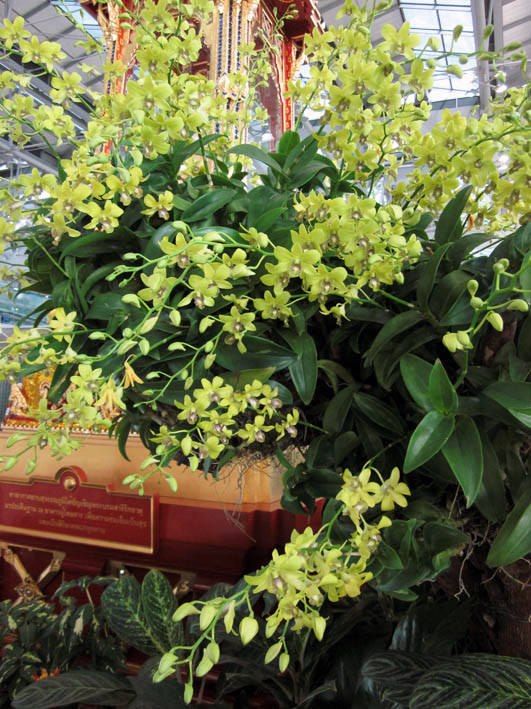
Besides this huge fabled display, the airport was decorated with beautiful flowers. Orchids were seen all over the airport but the massive display near the entrance was the most impressive. 

Purple Phalaepnopsis


Yellow Oncidium and white Phalaepnopsis


Vanda


Yellow Dendrobiums


Orchid varieties


Bromeliads


A variety of ginger plants, Curcuma, at the entrance of the airport.


View of Suvarnabhumi Airport from the runway.

A greeting card for 2013. 


Saturday, January 26, 2013

Kiss of the Cobra - A Tribute to the Year of the Snake

According to the Chinese lunar calender, the Chinese Spring festival falls on the 10th February 2013 which is the year of the water snake. There are twelve animals in the Chinese zodiac, thus the next cycle where the snake is featured will be twelve years away. Every 12-year cycle is associated with one of the five elements; wood, water, earth, fire and metal.


Snakes likeness on spiral Dracaena Sanderiana (Lucky Bamboo) for year 2013. The Chinese character 'Fu' on the old form of gold ingot means good luck or good fortune.

Something old and something new. I bought eight new stems of Lucky Bamboos and added six long stems of the old leafy ones. The latter were propagated from previous years' bamboo spirals. The leaves grew from the nodes in the spirals.


In July 2010, I was at the balcony of the Penang Hard Rock Hotel, enjoying the view below when I saw a crowd gathering round ...

a snake charmer. I quickly grabbed my camera and rushed down to join the crowd.


He had his 'precious' in the basket while a man with a tatoo of a frog hovered nearby, probably thinking of luring it out.

The Monocled cobra (Naja kaouthia) with its hood flared out, slithered languorously out of the rattan basket ...

towards its master for a reassuring smooch. Cobras are venomous snakes and their venom is a neurotoxin, affecting the nervous system. If not treated early, death occurs due to respiratory failure or cardiac arrest as a result of paralysis of the associated muscles.
 

The snake was swung up high for a good view of the audience. It seems cobras can  see very well even at night.


It was then brought down to eye level for an eyeball encounter. Meanwhile the snake flicked its blue tongue rapidly ...


and drooled too. Or perhaps it was from the snake charmer.

This is the King cobra (Ophiophagus hannah) which is the longest of the venomous snakes. It is light brown with pale yellow bands across the whole length of its body. It can be distinguished from other cobras from the inverted V stripe across the back of the head and neck instead of an eye (monocle) or two eyes (spectacles).


It too came for the smooch.


The Kiss, but not the mouth-to-mouth type.


So, gingerly, he tried again.


The King cobra was quite helpful and assisted in holding up the mike.


It was quite a handful to gather it up back into the basket.


 I'd rather have these cute, docile 'snake' buns for sale at a pastry shop anytime. They are yummy to boot.


This common garden snail glided determinedly on Dracaena Sanderiana (Lucky Bamboo) to rub off some of its luck. On its wish list is certainly one on being free from predators in the Year of the Snake, particularly the snakes themselves!!!


Monday, January 21, 2013

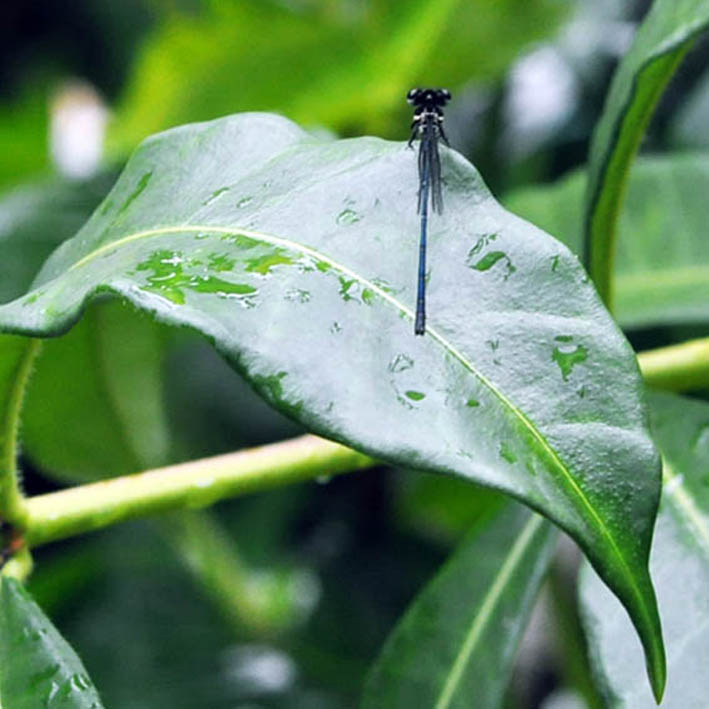
A Dainty Damselfly on Allamanda

Damselflies are similiar to dragonflies but are daintier. I used to think that they are the females. Compared to the dragonflies, their eyes are separate and thus appear more distinct.

I love the way this damsel held on to the edge of the leaf with the first and second pair of legs while the hind pair were thrusted against the leaf surface for anchorage.
“The amount of happiness that you have depends on the amount of freedom you have in your heart” - Thich Nhat Hanh

It then flew to another leaf for a different view of my garden.


When at rest the wings are held parallel to the abdomen. Besides the anorexic look, this is an easy way to distinguish them from dragonflies. The long slim abdomen must be the envy of many women.


Later it flew off to settle on a leaf of Allamanda violiacea.  Its jet-black body has a bluish sheen with stripes of white and dashes of purple on the head and thorax. And it has long, thick eyelashes to die for! The yellow background are the young leaves of Pseuderanthemum reticulatum.

 Pseuderanthemum reticulatum.


Allamanda violiacea or A. blanchetii


A variation with dual tones of cream and red 'sunset'.


 The leaves are hairy being covered with fine silvery-white hairs.


This variety of Allamanda has broader leaves compared to the dwarf variety. The blooms are bigger and the petals are thicker. Its colour is also deeper. The pink-white dainty flowers of Pseuderanthemum reticulatum are so teeny weeny compared to them.


The dwarf variety called Allamanda cathartica has small leaves which has a tendency to yellow and drop off prematurely, often leaving long bare canes on the lower parts.


Yellow flowers of Allamanda cathartica are towered above by the purple flowers of Allamanda violiacea. Note that the leaves are different.


A glass globe of yellow Allamandas (dwarf variety) and a smaller globe of pink Madagascar Periwinkles provided some much needed colour to my kitchen island top of 'black galaxy' granite.


Friday, January 18, 2013

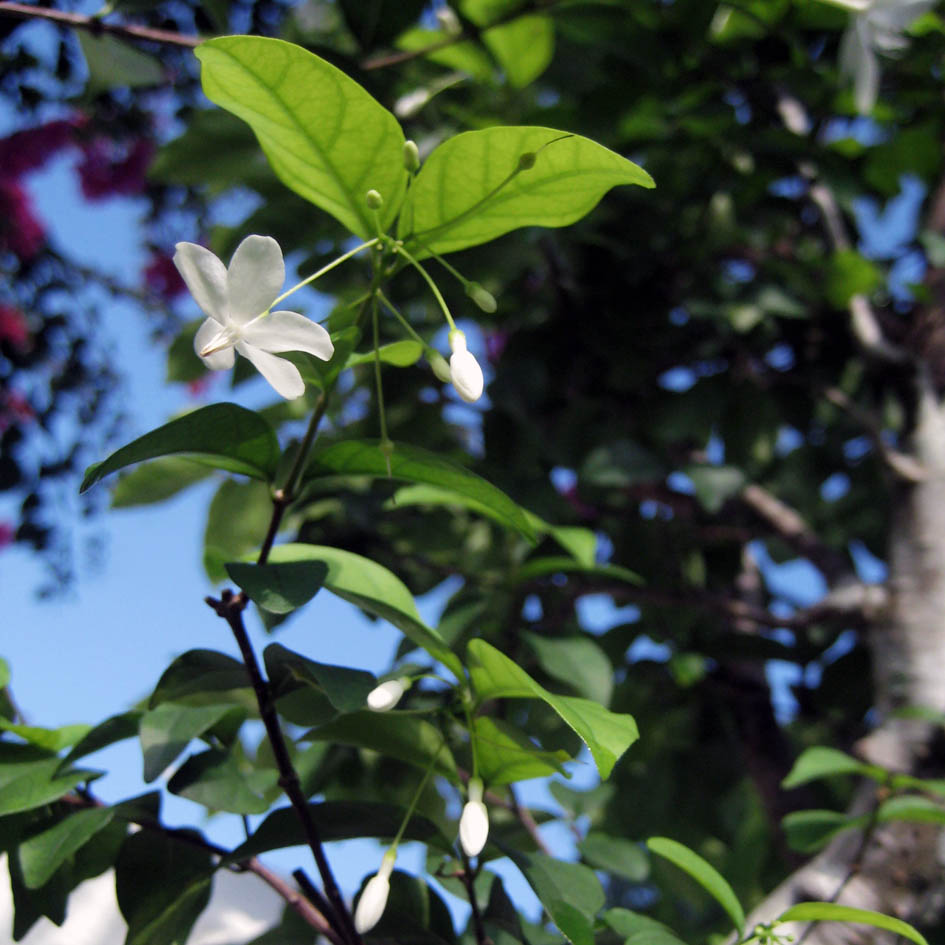
Wrightia Religiosa - Water Jasmine

I have too many Wrightia religiosa (Water Jasmine) bushes in my garden. Some are in containers while others are sprouting like weeds in the grounds. Suckers from established plants have also invaded adjacent areas.  I've pruned off many of these volunteer plants but they soon re-appeared with a vengeance. 
 
A black-white butterfly of unknown ID fluttered amongst the scented single-petaled flowers. It has lovely black-white pattern on the wings with some yellow on the head and thorax. 


It then fluttered to a braided planted in a container. Many stems are twined together in a basket weave pattern forming a cage.
 
The flowers here are of the double-petaled variety.


As the flowers of Wrightia religiosa face downwards, butterflies have to be upside down to get at the nectar.

 The abdomen is studded with black dots and end with a splotch of yellow at the posterior end.

 
However some of the flowers are single-petaled. The soft apple-green hue is due to the proximity of the leaves to the lens, the butterfly being in the centre of the bush.
Other than the antennae and eyes the head together with the proboscis is totally yellow. 


"The butterfly is a flying flower,
The flower a tethered butterfly"

~Ponce Denis Écouchard Lebrun


 These are single-petaled flowers.


 A split seed pod with feathery seeds ready for flight with a strong breeze or to be washed down with the pouring rain.


 Against the azure-blue sky.

Note: This moth should be a member of the Nyctemera genus as determined by Horace Tan of Butterflies of Singapore


LinkWithin

Related Posts Plugin for WordPress, Blogger...