Sunday, February 10, 2013

Chinese New Year and Spring Festival 2013

On the 10 February 2013, as the tail end of the dragon is seen trailing out, the water snake slithers in to herald the year of the Snake. It is the sixth animal of the Chinese zodiac.
 
A hissssssssy welcome to the kitchen by a friendly red snake. According to the ancient Chinese, a Snake in the house is a good omen because it symbolises a cornucopia of abundance for the household.


Ornaments for the festival usually have connotations of good fortune, good health, longevity, peace and prosperity.  The fish 'yu' for example denotes abundance. For the farmer, it would indicate a bountiful harvest. For married couples, they hope to have lots of progenies to populate the earth :)


Nian kau, a form of glutinous rice cake is traditionally offered to the kitchen God so that he would give a good report of the household or to seal his mouth if the report is negative :) Its yummy when sandwiched between a slice of yam and sweet potato, then fried to a crisp. Goes well with Chinese tea or kopi-O.


I remember eating Honey-comb cookies made by mum when I was a child.


A selection of traditional cookies
  
Topmost: egg roll (love letter) and spicy shrimp rolls
From 3 o'clock, clockwise: pineapple, chocolate-nut, butter-potato, green pea and peanut butter cookies.


Mandarin oranges (kam) is the homonym of gold in Chinese so is the most ubiquitous fruit around. It is one of the most popular gift to relatives, friends and business associates. The pomelo is used in a highly celebrated tossed-up salad dish 'yu sheng' which is frequently served on the seventh day or Man's day.

Green bottle gourd,  (Lagenaria siceraria) known as 葫芦 (hulu) in Chinese is a highly regarded fruit as it signifies happiness and wealth. In the olden days the dried gourds were used as flasks for water or wine. This one here has an image of a fish etched into it with a blowtorch. The fish image symbolises surplus or abundance.


  Plum blossoms (梅花) are traditionally symbolic of Chinese New Year as it is quintessentially spring.


A layered paper cut-out of colourful peonies for the door.


The leaves of the Draco are ornamented with tiny fake gold ingots.

Adenium obseum is another auspicious plant. Somehow at this time of the year all eight of my Adeniums are blooming.


A eight-foot tall braided Pachira aka money tree placed at the entrance and gilded lanterns ...

light up the driveway by night.


This is the Chinese character for snake. On the ang pow (a red envelope for placing money to be given away to children, family members or staff) packet from CIMB, is a stylised calligraphy of the character for snake.

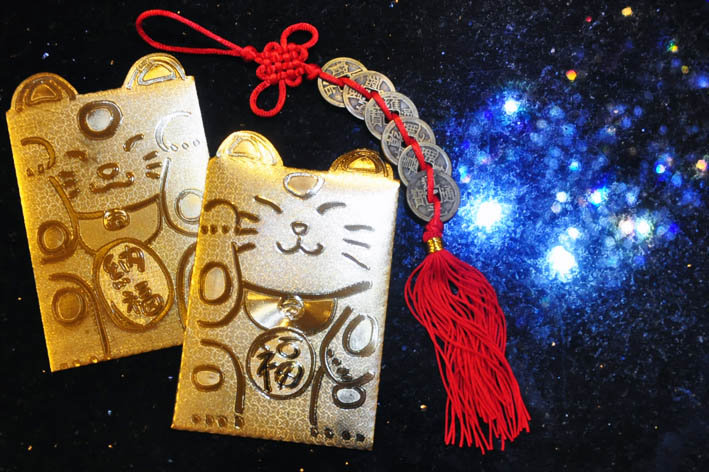
 
These prosperity-cat ang pow packets are from my parents. Originally from the Japanese creature, 'Maneki Neko', it is now widely adopted by the Chinese as the 'Zhao Cai Miao' or Beckoning Prosperity Cat.

Tasha getting in the mood for Chinese New Year and Spring Festival. She is seen here in a pose of the Beckoning Prosperity Dog. Tasha joins us in wishing all Chinese, and friends who celebrate the Spring festival with these felicitation:

"Wan Shi Ru Yi" meaning “May all your wishes be fulfilled”
 

Thursday, February 7, 2013

Ushering in Chinese New Year with Greens, Blooms and Fruits

The Chinese Spring Festival (Chun Jie / 春节) which falls on 10th February 2013 is celebrated worldwide by the Chinese diaspora regardless of religion. It has no religious connotations, simply the joyous celebration of Spring, though very often, those of the Taoist persuasion offer thanksgiving prayers to the Heavens or deities and also for a smooth year ahead. During this period, Chinese homes are spruced up with plants, fresh flowers, and fruits following a long tradition of symbolising Spring and rejuvenation. A feel of Spring and festivity is strongly palpable even though in the tropics there is only the wet or dry season.
  
This azalea was bought three years ago and is still hale and hearty. It was from Holland and generally notorious for not blooming at all thereafter. So I was quite thrilled when it blooms frequently.

 
 It is pink with streaks of white.

This year I bought this salmon coloured azalea. The nursery people assured me that the China variety will definitely have repeat blooming.

I plonked it into this ceramic container with oriental design.
  
During this season many flowers, fruits and plants considered auspicious are on sale. They are steeped in symbolism of good fortune. Nurseries and florists are chokeful with a vast array of vegetation and cut flowers.

Huge blooms of Hippeastrum grown from bulbs.


Kalanchoes in lavender and vermillion are popular buys.

Hydrangeas from Holland is a standard offering at nurseries.


Chrysanthemums come in various colours, textures, sizes, shapes and petal configurations. For those who want them to last an eternity can opt for the fake ones as seen in the last photo, above. I was clicking away, thinking that it was real plant until I saw the not so realistic leaves.
  
 
Solanum pseudocapsicum symbolises abundance and fertility.


 Calamansi (Citrofortunella microcarpa)


 I'm not sure whether these fruits are tangerines or clementines.


This is the window display of Robinson at Gardens, a shopping mall in the capital. 'Chun' - Chinese character for Spring is written with fake calamansi.
Chinese Symbol Image spring

 
Braided Dracaena Sanderiana (Lucky Bamboo). The 'cage' is symbolic of trappings of wealth.


A broad strapped-leaf Bromeliad


 Pineapple (Ananas comosus) belongs to the Bromeliad family too.


It is considered an auspicious fruit. I bought heaps of these pineapples not so much for the message it conveys but more for consumption. They are sweet and juicy eaten fresh and the pulp is cooked with sugar to fashion into pineapple cookies.

 
It is a tradition for me to make these pineapple cookies for Chinese New Year. I stick a clove in each to represent the stalk and it gives the cookie a mild spicy flavour. Tiny gold ingots and traditional gold coins are some of the ubiquitous ornaments.


Here's to wishing all Chinese bloggers and those who celebrate this festival, 
"Gong Xi Fa Cai and Happy Chinese New Year"


Friday, February 1, 2013

Churning the Ocean of Milk - A Tribute to the Year of the Snake

To commerate the year of the snake, I dug into my archive of photos from my travels. I've not been to Bangkok for a while, so in June 2011 after  passing through Immigration at Suvarnabhumi Airport, I was pleasantly surprised by a huge colourful scene of 'The Churning of the Ocean of Milk'. This scene has its roots in Hinduism and is found in the ancient Purana scriptures. Due to a curse from an offended sage, the Devas (demi-gods) lost their divine powers and thus sought to regain it by getting hold of amrita, the nectar of immortality. They came up with an elaborate scheme which involved forging an alliance with the Asuras (Demons) to churn up the ocean of milk in order to retrieve it. For this purpose, they used Vasuki, the seven-headed serpent (cobra) as a churning rope by coiling it around Mount Mandara as a pivot and tugged at it from both ends.

The section of the serpent, Vasuki, with the seven heads ...

 
was held by the Asuras (demons).

The Devas were well-advised by Vishnu not to take this end. 

 
The mid-section of Vasuki was coiled round Mount Mandara which acted as a pivot. The resulting force from the churning was so great that eventually Mt Mondara broke off and sank. Vishnu through his avatar, Kurma the tortoise bore up the mountain.

On the other side, the tail end of Vasuki ...

was held by the Devas which was a smart move as they avoided the poisonous fumes from the seven roaring mouths of Vasuki.


Eventually a total of 14 precious objects and treasures were retrieved. The culmination was the nectar of immortality which was delivered by Dhanvantari, the physician of the Gods. As the nectar was coveted by both parties, a fracas broke out and it ended up in the hands of the Asuras.

Vishnu then saved the situation by turning into Mohini the enchantress. Through her shenanigans she managed to snatch it away from them and fed it to the Devas who then regained their divine powers of immortality.


Besides this huge fabled display, the airport was decorated with beautiful flowers. Orchids were seen all over the airport but the massive display near the entrance was the most impressive. 

Purple Phalaepnopsis


Yellow Oncidium and white Phalaepnopsis


Vanda


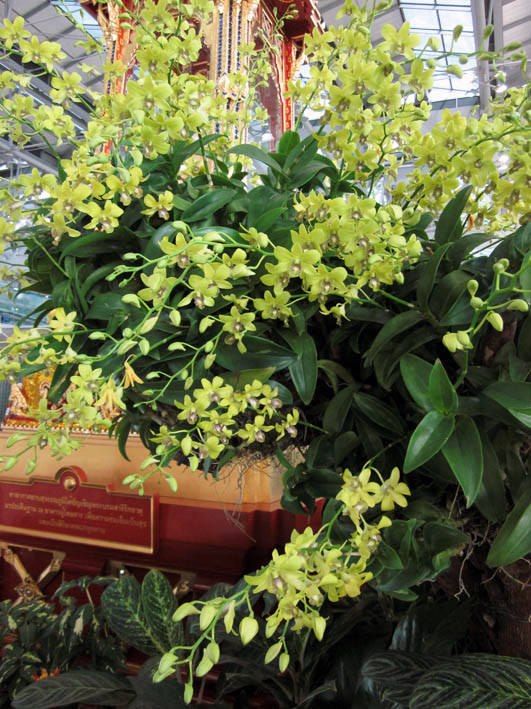
Yellow Dendrobiums


Orchid varieties


Bromeliads


A variety of ginger plants, Curcuma, at the entrance of the airport.


View of Suvarnabhumi Airport from the runway.

A greeting card for 2013. 


LinkWithin

Related Posts Plugin for WordPress, Blogger...