Tuesday, March 19, 2013

A Bulbul's Frolic on Conifers

The Yellow-vented Bulbuls (Pycnonotus goiavier) are regular visitors to my garden.  Berries, seeds and small fruits form their staple diet. They also sip nectar, nibble on tender leaves, and feed on some insects.


A Yellow Vented Bulbul (Pycnonotus goiavier) chirped happily in the sun under a floral canopy of deep pink Bougainvillea and orange Bauhenia kockiana.


It then flew off to a nearby Juniper (Blue Pine) and nestled in its pine needles. A deep pink Bougainvillea is in the foreground.

 
Inquisitive and curious.
This juniper which I've planted about twenty years ago appears to be reaching towards the sky.

 
Another Bulbul decided to perch on a newly pruned (second phase) Platycladus orientalis (Thuja Orientalis) and soaked in the sun. I pruned this tree as it was getting too thick, thus blocking the sun from the smaller shrubs below.
 

When it had enough of sun bathing it burrowed into the interior of the tree to enjoy the some cool shade.

This is the first stage pruning of the Platycladus orientalis (Thuja Orientalis). I normally pruned my shrubs and trees in stages as hard pruning can cause the plant to die. A trailing inflorescence of Bauhenia kockiana enticed birds to it.


Wednesday, March 13, 2013

Jatropha podagrica and the Green Grasshopper

I remember forever having Jatropha podagrica (Buddha Belly Plant) in my garden. They are self-seeding and generally flourished without much effort on my part.

The leaves are large and round  with a few shallow indents.  Spines radiate from the centre of the leaf giving it a star shape.


Upright flowers stalks soon follow. Five flowers of the inflorescence are in anthesis while the remaining tiny round globes are probably the male flowers.


The fruit is large compared to the flower. It is in the form of an elongated globule and consist of five segments.


 Pollination is a frequent success story with fruits forming easily. It is  evidenced here by the presence of five well-formed fruits. 


The fruits are a powdery light teal green colour which is quite similar to the colour of the leaves. They stay on the stalk for many weeks before bursting.


The stem of the plant is swollen hence its moniker, 'Buddha Belly'. Its characteristics are similiar to succulents. When any part of the plant is broken off, a light murky sap oozes out.

 
I was snipping off the half chomped-off leaves of the Pseuderanthemum reticulatum when the mystery of the jagged leaf edges was uncovered.

 
The uninvited dinner guest was a homogeneously green grasshopper. being caught red-handed, it quickly hopped on to a sturdy leaf stalk of Jatropha podagrica.


Through the filtered sunlight, the limbs appeared like translucent jade. Only the reddish-grey antennae and yellow spikes on its lower leg detract from its homogenous green colour. The claws have a reddish tinge. I thought they look like manicured and pedicured painted nails.

 
Here its head is seen admist the leaf, flowers and fruits.


It clinged on the stalk with its vice-grip.


Before long it decided to ascend by spreading out its limbs all over for anchorage until it could clutched the edge of a leaf.

It then heaved itself up on to the leaf surface.

 Old Tibetan rosary comprising one hundred and five-beads. The black beads are interspersed with yellow ember, sky-blue turquoise, red coral and silver beads. (From my sister's collection of antique beads and baubles).


Monday, March 11, 2013

Zephyranthes - Rain Lilies

Rain Lilies or Zephyranthes are plants when once planted will live forever in your garden.  Over time, every single bulb will establish a sizable clump to reward us with its mass blooming effect. I have two varieties; the pink called Z. rosea while the white is tagged Z. candidia.

Here a Common Green Darner dragonfly (Anax junius) is totally engrossed with a Zephyranthes candida.


The six-petaled white flowers sprout like mushrooms after our heavy tropical showers, thus they are sometimes refered to as Thunder lilies.

 
 A row of blooms standing erect alongside a boulder.

Being fast multiplying bulbs, the original borderline clumps has spread inwards, forming a thicker border.


Here they border some ...

... Ixora coccinea 'sunkist' shrubs.


The flower appear dramatic with golden stamens arising from the flower's green throat. Ants are gatherers here too.
 
 
A Gram Blue (Euchrysops cnejus) seeked a brief respite from the harsh mid-day sun.

Zephyranthes rosea appear to bloom less frequently than its white cousins. Both however, have pristine white pistils.


Sunday, March 3, 2013

An Eurasian Tree Sparrow Scratches an Itch

The Eurasian Tree Sparrow (Passer montanus) is as ubiquitous as ever in Malaysian gardens, including mine. Initially, I did not want to shoot them as they seem so drab in their brown and black. As there were so many around and created a ruckus all day long, it was inevitable that they eventually got to be photographed.
 
On close-ups sparrows are not just brown with darker patches.


Immediately below its black bill, a distinctive black marking is seen on its throat which tapers towards the upper chest. On each side of its white cheek, a black patch distingusihes it from the house sparrow.  Its belly is white or of lighter hue.

The crown is reddish-brown.  The upper part of the body is brown with black markings all over, particularly near the tips of feathers which are trimmed with a an edge of white. 


A favourite hang-out for them is my red Hibiscus bush where they can bask in the filtered sunlight through the canopy of leaves above. 


Another favourite hang-out is the top of the perimeter brick fencing in the garden.


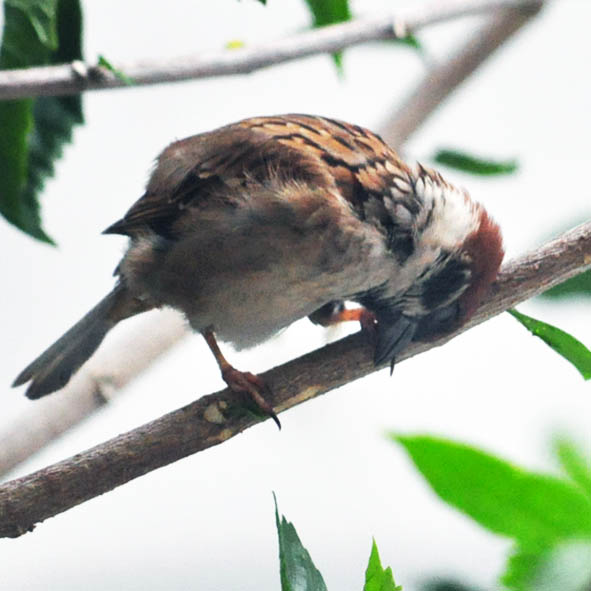
This one was seen busy pecking away at its underside. I thought it was preening, but on observation, it could also be scratching an itch.

It then turned to the right side to continue scratching. The more it scratched, the more engrossed it became.


Every now and then in between preening, it moves towards the base of the tail, presumably to distribute a special oil that is secreted from a gland. This oil helps to give a sheen to its feathers and to keep it in good condition.  

After a bout of this activity, it seems to be absolutely relieved.

But then an itch occurred around its throat area which is impossible to peck at with its beak. This was simply solved by kicking its feet up to scratch the itch.

Its long toe-nails seem to be suited precisely for the job.

Now, the itch has spread to its crown. So, rubbing the head on the rough bark should do the job nicely.


That felt so good! After a short while,
  
the underside of the wings too needs some working on too.

Now the back too needs to be scratched ...

Here it sat, nicely preened and fluffed up. I strongly felt like dusting it with some talcum powder to finish the job.


LinkWithin

Related Posts Plugin for WordPress, Blogger...