Sunday, March 3, 2013

An Eurasian Tree Sparrow Scratches an Itch

The Eurasian Tree Sparrow (Passer montanus) is as ubiquitous as ever in Malaysian gardens, including mine. Initially, I did not want to shoot them as they seem so drab in their brown and black. As there were so many around and created a ruckus all day long, it was inevitable that they eventually got to be photographed.
 
On close-ups sparrows are not just brown with darker patches.


Immediately below its black bill, a distinctive black marking is seen on its throat which tapers towards the upper chest. On each side of its white cheek, a black patch distingusihes it from the house sparrow.  Its belly is white or of lighter hue.

The crown is reddish-brown.  The upper part of the body is brown with black markings all over, particularly near the tips of feathers which are trimmed with a an edge of white. 


A favourite hang-out for them is my red Hibiscus bush where they can bask in the filtered sunlight through the canopy of leaves above. 


Another favourite hang-out is the top of the perimeter brick fencing in the garden.


This one was seen busy pecking away at its underside. I thought it was preening, but on observation, it could also be scratching an itch.

It then turned to the right side to continue scratching. The more it scratched, the more engrossed it became.


Every now and then in between preening, it moves towards the base of the tail, presumably to distribute a special oil that is secreted from a gland. This oil helps to give a sheen to its feathers and to keep it in good condition.  

After a bout of this activity, it seems to be absolutely relieved.

But then an itch occurred around its throat area which is impossible to peck at with its beak. This was simply solved by kicking its feet up to scratch the itch.

Its long toe-nails seem to be suited precisely for the job.
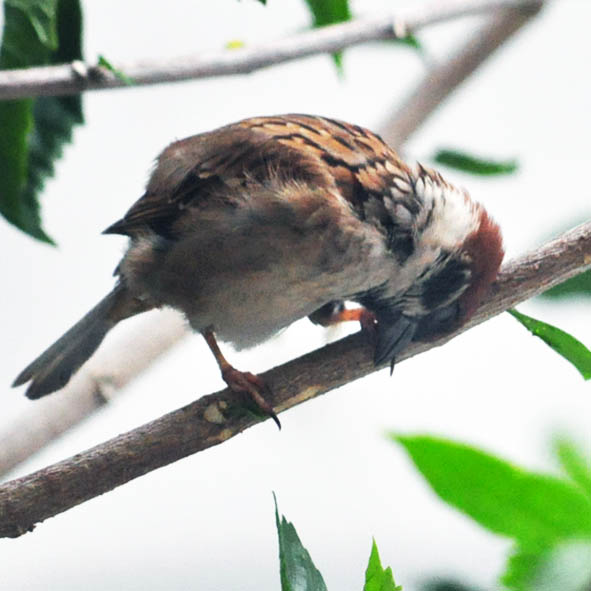
Now, the itch has spread to its crown. So, rubbing the head on the rough bark should do the job nicely.


That felt so good! After a short while,
  
the underside of the wings too needs some working on too.

Now the back too needs to be scratched ...

Here it sat, nicely preened and fluffed up. I strongly felt like dusting it with some talcum powder to finish the job.


Tuesday, February 26, 2013

Meanies and Crawlies on my Calamansi

Potted Calamansi plants (Citrofortunella microcarpa, limau kasturi in the Malay language) are ubiquitous during the celebration of the Chinese Spring Festival. I have several pots left from previous years. My calamansi plants have a magnetic appeal for all sorts of critters.
The caterpillar of the Lime butterfly (Papilio demoleus malayanus) crawled all over the plant in search of the juiciest leaves to feed on. It masticated voraciously as evidenced by the jagged edges of gnawed leaves and its droppings. It even had the audacity to chill out on my prime fruits besides casually depositing its droppings. The outcome of which is a very suggestive pose. Honest, I didn't staged this scene. Actually this particular scene started me on the thread of this post.

This newly emerged Lime butterfly, settled on a leaf of the hedge (Baphia nitida) to dry out and warm up. 

Here under the bright morning sunshine it flapped its wings up and down with slow incisive motions. I can almost feel it purring with pleasure.

While strutting its stuff, its underside was displayed in all its 'batik' glory.


A Green Shield Bug with mean beady eyes laid seige on its territorial turf; leaves that had yellowed and had seen better days.
 
However it then turned around to shrewdly contemplate its next course of action ...


 on moving to greener pastures.


 Somewhere else on the shrub, a tiny ladybug quietly tried to navigate its way between the leaves.


This Pied Shieldbug (Sehirus bicolor) is the new kid on the block, but had snugly ensconsed itself in lush lime foliage.

It also wanted to stake its claim on a piece of prime property and had chosen this promising green citrus, hugging it covetously.


On the other hand, ants do not partake of foliage or fruits, instead they have their hands full gathering nectar and pollen from the Calamansi flowers. 

The larvae of some citrus Leafminers left evidence of their nefarious activities on the undersurfaces of some lime leaves.


This plant is a legacy from last Chinese New Year's purchase of ornamental plants. My Calamansi plants have served me well. I harvest the fruits almost daily to zest up my juices, cocktails and sambal belacan. It is most flavourful as its fragrance and aroma is unique unlike Citrus aurantifolia (Limau nipis in Malay) which is just plain sour.


A platter of oranges, calamansi and bananas ready to be blended. As many creepy crawlies have a run all over the plant and fruits, I scrub the fruits thoroughly with soap before using.


The fruit platter makes five glasses of refreshing fruit juices and is loaded with oodles of vitamin C. As I sipped the juices, I can feel its goodness coursing through me :)


Friday, February 22, 2013

Adenium obesum - Desert rose

I've always thought of Adenium obesum (Desert rose) as miniature Frangipani (Plumeria). The strong resemblance is in the bare fleshy stems carrying terminal leaves and bunches of flowers. Both have thick succulent stems which exude a milky sap when any part of the plant is cut. But here the similarity ends, as the stems of the Adeniums grow increasingly in girth, thereby earning its moniker 'obesum'.

The Chinese consider Adeniums as  auspicious plants. 

As if mindful of their obligations and duties, my Adeniums bloomed right on cue, just in time for the Chinese New Year. It is framed by the fan-like leaves of the Licuala grandis (Fan palm).


This has chilly red flowers and white corollas. It is always the first one to flower. I take this as the harbinger of the Adenium season when the weather is warmer and dryer. 

However, throughout the CNY period this year, it has been raining cats and dogs . Certain parts of the city were flooded.


 Blooms last up to a week if placed away from direct sunlight. The uprighr blades of Walking Iris is to the left.

The petals are thick and feels velvety while the white corolla is covered with fine hairs and this extend to the stamens too.


This photo of the Adenium plant was taken about 18 months ago. 
This was taken about one year later. As you can see from the two pictures above, Adeniums grow slowly.

At the moment, about 8 months later, the only two branches have grown longer. It looks leggy but I let it be as it always seems to be blooming. The Calamansi plant is from two CNY seasons ago. Fruits are scanty as they have been harvested for adding zest to drinks and food.
 

This variety is white with radiating tongues of red from the centre towards the edge of each petal.

 
The flower is basically white, trimmed in black and red. 


As the flower matures, the white portion gradually turns to pink, 


while the black trim turns to dark purple.


This has a pink lavender hue and a deep red to maroon corrolla 

 
In the pink variety, the stamens and stigma appear to be fused together.

A single seed pod has many seeds. Tufts of hair are found on each end of the seed.


Year of the Water Snake (2013)
A pink Adenium obesum to signify the celebration of the Spring Festival according to the Chinese solar-lunar calender. The double-headed snake bangle is from my sister's antique silver collection.


LinkWithin

Related Posts Plugin for WordPress, Blogger...